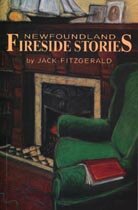
Excepts from Newfoundland Fireside Stories is available for online reading.
Newfoundland Fireside Stories is the fourth book in a series of offbeat histories about Newfoundland places, people and historical events. In these stories Fitzgerald continues his research into the strange, the amazing and the almost unbelievable happenings culled from the archives of Newfoundland's history, and from its folklore.
Excerpt #1: Benevolent Irish Society
Although the BIS is today considered a Roman Catholic organization, it was actually founded by a group of Irishmen, most of whom were Protestants, and its first executive had only one Catholic member, Henry Shea, secretary.
When the BIS was conceived, Newfoundland had a total population of twenty-two thousand, with only four thousand in the city of St. John's. The military garrison in the city held seven hundred men and some of them were leaders in organizing the BIS. The city was quite small with wooden tenement houses huddled close together and Merrymeeting Road was considered the back of town.
There were no welfare programs a the time and the long cold winters brought great hardships to the poor of Newfoundland. A group of Irishmen comprised of military men and civilians saw the need for some kind of organized help for the poor. Several meetings took place during February 1806 which resulted in the formation of the BIS with an initial membership of seventy-four. The BIS was a non-denominational society founded on the principles of benevolence and philanthropy, which its organizers felt would be the most effective way of establishing a permanent relief program for the poor. The first President of the BIS was Captain Winckworth Tongue and while it was founded at a meeting in the London Tavern in the east end of St. John's, its first meeting was held in the old court house while all meetings between 1817-1827 were held at the Crown and Anchor and Globe taverns.
Originally the membership was confined to natives of Ireland, sones of Irish parents, and descendants of any present or past members. The rules ordered members to avoid all controversy of religious or political subjects.
The organizing group worked closely with R.C. Bishop James O'Donnel because he was universally respected in Newfoundland and had an expert knowledge of the people.
The seal of the BIS consists of the figure of St. Patrick bearing the cross with the motto encircling, "He that gives to the poor, lends to the Lord."
The BIS also decided in its founding year to celebrate their annual festival on the 17th day of March and to commemorate Holy St. Patrick who first preached the Christian religion to the Irish. When Bishop O'Donnel left Newfoundland due to illness the BIS presented him with a silver urn in appreciation of his 23 years of service in Newfoundland and especially his help to the BIS.
Excerpt #2: Prime Minister Edward Morris
During the period Sir Edward Morris served as Prime Minister of Newfoundland, Roman Catholics strictly adhered to their Church's rule of abstaining from eating meat on Fridays. Sir Edward once found himself in political hot water because of this practice.
Word reached his enemies that he had eaten meat on Friday while visiting a Protestant community at Grand Bank. In those days such a violation of church rules would be enough to ruin any politician. Sir Edward's enemies in Kilbride hoped to turn the Catholic vote in St. John's West against him. On his return from Grand Bank, the Prime Minister was scheduled to speak at a rally in Kilbride, His enemies filled the hall.
Their leaders were planning on raising the issue and confronting Sir Edward int he presence of his loyal supporters. Anticipating this sort of trouble, the politically shrewd Morris rose before the meeting to make a special announcement. He began by denouncing the vile rumours circulating that he had sacrificed his religion by eating meat on Friday to get votes in a Protestant district.
Morris admitted that he did eat meat at Grand Bank but explained he was in a delicate state of health with problems similar to that of the Archbishop. He then plucked a document from his pocket which, in reality, was a life insurance policy and he began reading improvised Latin phrases.
Holding the document up for the crowd to see, he claimed it was a papal document of dispensation from the Vatican. Morris concluded with a denunciation of his opponents for criticizing the Pope's authority. Completely won over, his former enemies surged toward the stage and lifted the Prime Minister on their shoulders. They then carried him around the Kilbride hall in a victory procession.
|


 All Prices are in Canadian Dollars
 Newfoundland Mummers for 2014!
 Newfoundland & Labrador Wrapping Paper